How HPLC Confirms Peptide Purity in Testing
A peptide labeled 99% pure is not meaningfully verified by the number alone. The relevant question is how that value was produced, what the analytical method could detect, and whether the result belongs to the exact batch under review. This is how HPLC confirms peptide purity: it separates components within a sample, measures their relative chromatographic response, and provides a traceable record that can be evaluated alongside other quality data.
For research buyers, HPLC is not merely a technical abbreviation on a Certificate of Analysis. It is a central part of establishing whether a peptide material is consistent with its stated specification and whether visible impurities have been resolved and accounted for. Proper interpretation still requires context, including method conditions, peak integration, sample identity, and complementary mass spectrometry data.
What HPLC Measures in a Peptide Sample
High-performance liquid chromatography, commonly called HPLC, separates compounds based on how they interact with a stationary phase inside a column and a liquid mobile phase moving through it. Peptides with different hydrophobicity, charge behavior, sequence-related properties, or degradation profiles may travel through the column at different rates.
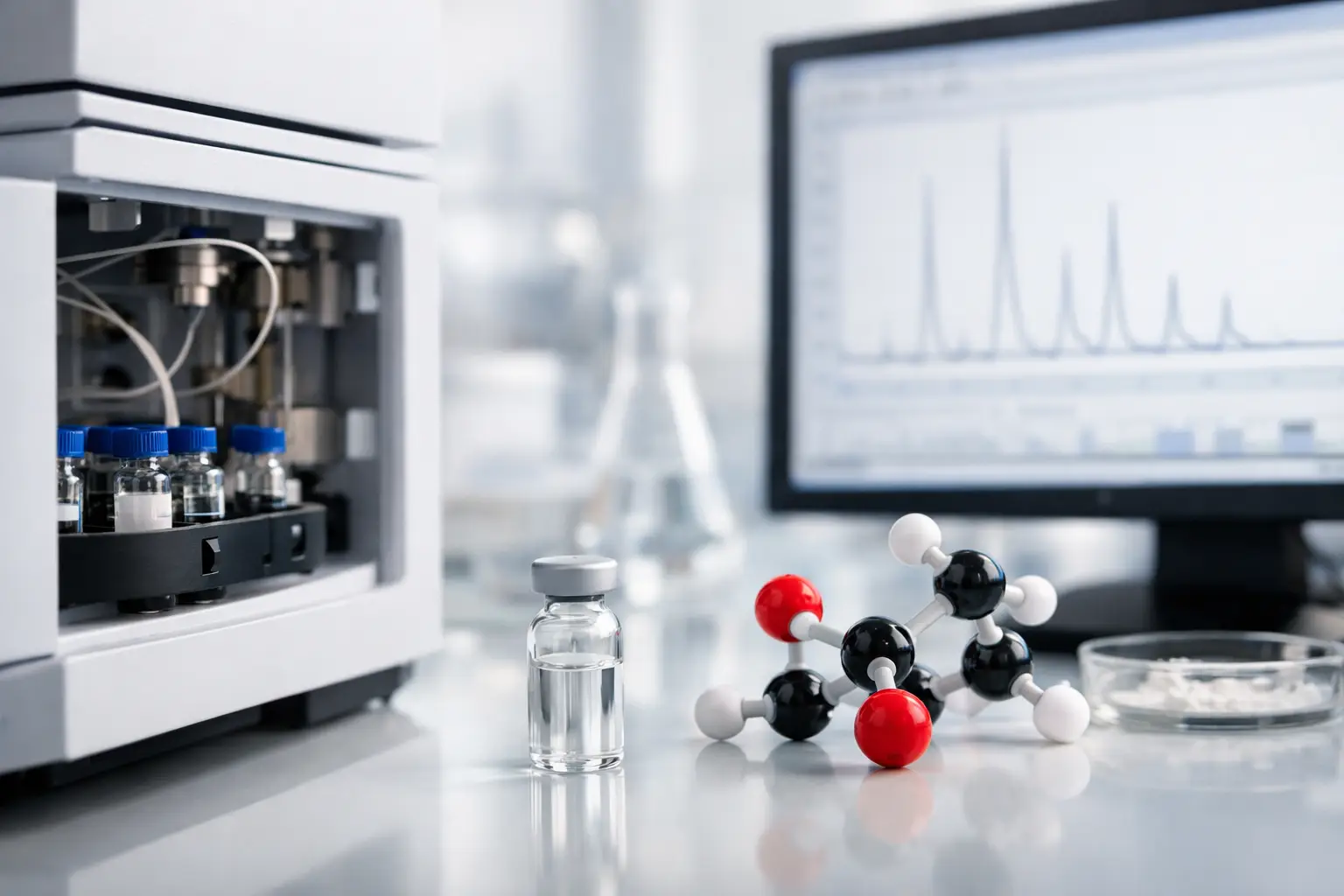
In a common reversed-phase HPLC method, the sample is introduced into a column with a nonpolar stationary phase. A water-and-organic-solvent mobile phase, often run as a gradient, carries sample components through the system. As each component elutes, a detector records a response at a selected wavelength. The output is a chromatogram: a plot of detector response against retention time.
A material that is predominantly one peptide component will generally produce one dominant peak under a suitable method. Smaller peaks may indicate process-related impurities, truncated sequences, deletion products, oxidation products, residual synthesis byproducts, or other detectable components. The area of the main peak relative to the total integrated peak area is commonly used to estimate chromatographic purity.
That wording matters. HPLC typically reports chromatographic purity under defined conditions. It does not automatically prove every peak is chemically harmless, establish biological activity, or identify the molecular structure of every minor component.
How HPLC Confirms Peptide Purity From a Chromatogram
The analytical process begins well before a chromatogram is generated. A representative sample must be prepared at an appropriate concentration, dissolved in a suitable solvent, and analyzed with a method capable of separating the target peptide from likely related substances. Poor solubility, inappropriate injection concentration, or inadequate separation can compromise interpretation.
Once the run is complete, the analyst reviews the chromatogram for the expected retention profile and evaluates peak integration. If the main peptide peak accounts for 99.0% of the integrated area, for example, the reported HPLC purity may be 99.0%, subject to the method and integration parameters used.
The quality of the separation is as important as the final percentage. A single broad or poorly resolved peak can conceal co-eluting components. Conversely, a clean, symmetrical dominant peak with baseline separation from nearby minor peaks provides stronger evidence that the method has distinguished the principal peptide from detectable impurities.
Retention time is another useful control point. When a reference standard or an established batch profile is available, the expected peptide should elute within an appropriate retention window under the same method. Retention time alone is not definitive identification, since different compounds can occasionally elute similarly, but it is a meaningful consistency check.
Peak area is useful, but it has limits
Area-percent calculation assumes that components produce comparable detector responses at the selected wavelength. This is often practical for peptide purity assessment, particularly with UV detection, but it is not equivalent to an absolute mass fraction for every possible impurity.
Some contaminants may have weak UV absorbance, may not elute under the method, or may be below the method’s detection threshold. HPLC purity should therefore be read as evidence produced by a defined analytical system, not as a blanket claim that no other material exists in the vial.
For research procurement, this is why a documented test method, clear reporting, and batch linkage carry more weight than an unsupported purity percentage on a product page.
Why Method Conditions Matter
Two laboratories can analyze the same peptide and produce different chromatograms if their conditions differ. Column chemistry, mobile-phase composition, gradient profile, flow rate, temperature, detection wavelength, injection volume, and sample diluent all influence retention and resolution.
A suitable peptide HPLC method should be fit for its purpose. A method intended to screen for broad purity may not resolve every closely related sequence impurity. A more demanding method may use an adjusted gradient, alternate column chemistry, or different detection settings to improve separation around the main peak.
Method validation or qualification provides additional confidence. Depending on the testing context, laboratories may assess precision, specificity, linearity, accuracy, repeatability, and limits of detection or quantitation. Not every research-use COA will provide a full validation package, but the presence of specific method information and a traceable laboratory record is materially stronger than a generic statement that a product was “tested.”
HPLC and Mass Spectrometry Answer Different Questions
HPLC and mass spectrometry are often discussed together because they address complementary quality questions. HPLC is especially useful for separating components and estimating the relative abundance of the main chromatographic peak. Mass spectrometry helps confirm whether the principal component has a molecular mass consistent with the intended peptide.
For a peptide material, a strong analytical package commonly shows an HPLC result indicating high chromatographic purity and a mass spectrometry result aligned with the expected molecular weight. This pairing reduces uncertainty in two different ways: HPLC evaluates the sample’s separation profile, while mass spectrometry supports identity confirmation.
Neither technique should be overstated. A correct mass does not establish high purity, because impurities may be present in the same sample. Likewise, a dominant HPLC peak does not independently confirm that the peak is the intended peptide. Reviewing both results together is more defensible than relying on either one in isolation.
Additional testing may be appropriate depending on the material and study requirements. Moisture content, residual solvents, counterion content, microbial controls, endotoxin testing, and stability evaluation are separate considerations. The appropriate test panel depends on the compound, formulation, intended research environment, and risk profile.
What to Review on a Peptide COA
A COA should allow a buyer to connect the result to a specific material rather than simply accept a marketing claim. At a minimum, researchers should look for the peptide name or identifier, lot or batch number, test date, reported purity result, analytical method, and laboratory information.
When HPLC data are presented, the chromatogram itself can provide useful context. Review whether a dominant main peak is visible, whether minor peaks are apparent, and whether the reported result corresponds to the integrated profile. The document should be legible, internally consistent, and clearly associated with the purchased batch.
Batch-specific verification is particularly important for peptides because quality cannot be assumed to remain identical across unrelated production lots. A COA from a prior batch is not evidence for the vial currently under consideration. QR-based COA verification and batch tracking help reduce this gap by allowing the analytical record to be checked against the labeled lot.
At PeptydLab, batch-specific documentation, HPLC, and mass spectrometry records are positioned as verification controls for research materials, not as substitute claims for unauthorized use. Products are supplied for laboratory research use only and should be handled according to applicable institutional procedures.
Common Misreadings of HPLC Purity Claims
A high HPLC value is meaningful, but it should not be treated as a complete quality profile. Researchers should avoid several shortcuts when evaluating purity documentation:
- Treating a purity percentage without a batch number as verified evidence.
- Assuming a clean-looking chromatogram confirms peptide identity without mass data.
- Comparing results from different methods as though they were directly interchangeable.
- Assuming high chromatographic purity establishes sterility, endotoxin status, or stability.
The practical standard is not perfection in a single data point. It is a coherent analytical record: a traceable batch, an appropriate HPLC result, identity support from mass spectrometry, controlled handling, and documentation that can be reviewed before the material enters a study.
Applying HPLC Data to Research Procurement
For qualified research buyers, HPLC documentation is most useful when it informs a controlled receiving and review process. Match the product label to the COA lot number, retain the documentation with the study file, and assess whether the stated purity meets the protocol’s acceptance criteria. If a project requires a particular impurity threshold or additional release testing, establish that requirement before purchase rather than interpreting a general COA after receipt.
It also helps to distinguish analytical purity from experimental suitability. A highly pure peptide may still require appropriate storage, reconstitution controls, handling practices, and stability planning to remain suitable during a study. The supplier’s verification record is the starting point for material confidence, while laboratory controls preserve that confidence through use.
A well-documented HPLC result gives researchers something concrete to evaluate: not a promise, but a batch-linked measurement with defined limits. That distinction supports better purchasing decisions and more disciplined research records.